In 2024, your computer is your classroom, your library, and your social club. For an international student, this “Digital Life” is amplified because your laptop is also your only link to home. But staring at a screen for 12 hours a day has a massive cost to your mental and physical health. Digital wellbeing for students is the practice of creating a healthy relationship with technology so that it empowers your studies rather than draining your soul. If you are constantly distracted by notifications or suffer from “App Fatigue,” your GPA and your prestigious scholarship goals are in danger. In this guide, we explore how to master your digital environment and reclaim your focus in a world designed to steal it.
The “Dopamine Loop” and Academic Procrastination
The first challenge to digital wellbeing for students is the Dopamine Loop. Apps like TikTok, Instagram, and even LinkedIn are designed to keep you scrolling. Every time you get a notification, your brain gets a tiny hit of pleasure. This makes deep, focused work (like writing a scholarship research proposal) feel painful by comparison. To break the loop, use tools like **Freedom** or **Cold Turkey** to block distracting sites during study hours. You must protect your “Deep Work” time like it is a precious commodity.
Setting Digital Boundaries: The “Bedroom Workspace” Rule
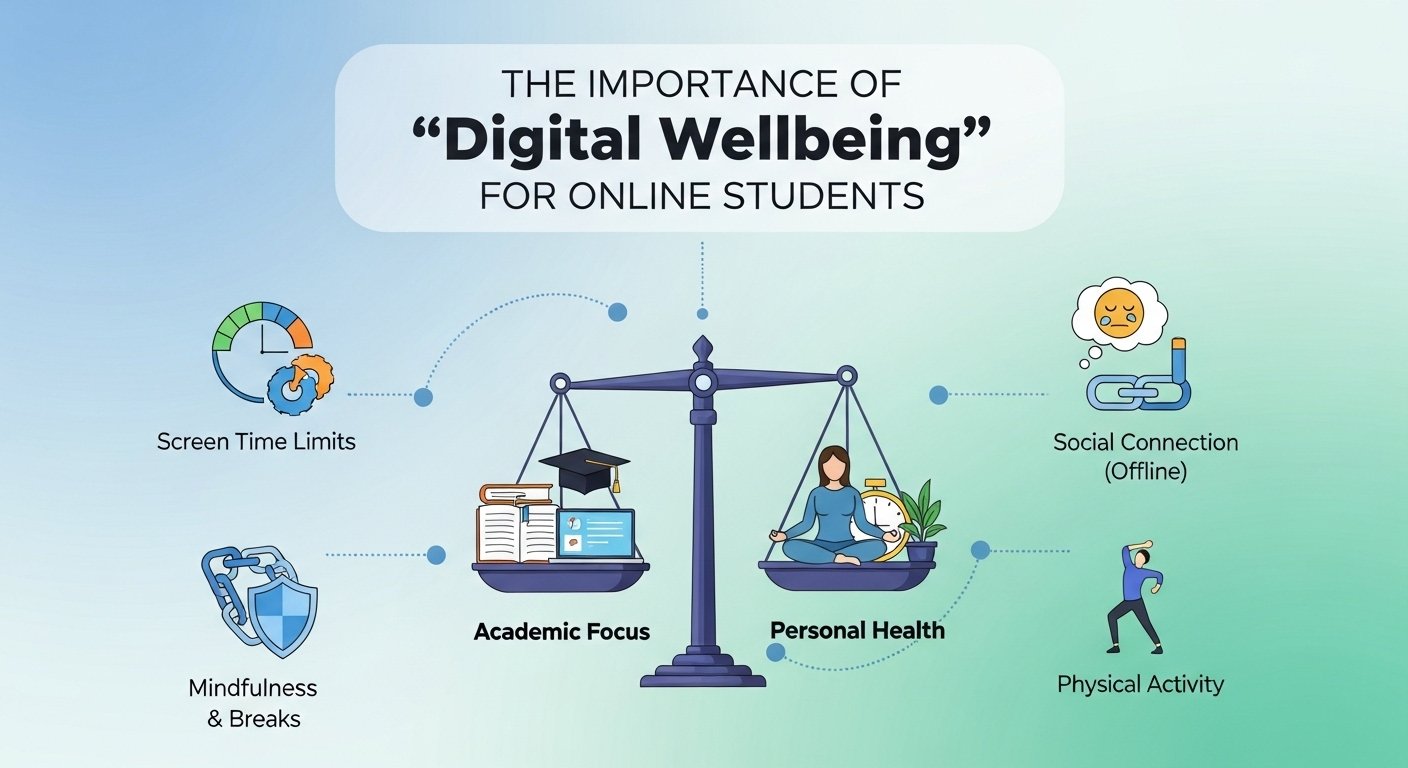
Because many students study in their bedrooms, the “Work-Life Balance” disappears. For the sake of digital wellbeing for students, you must create a boundary. – **Physical:** Never study in bed. It ruins your posture and tells your brain that your bed is a place of stress, leading to insomnia. – **Digital:** Use “Focus Modes” on your phone. Have a “Study” mode that only allows emails and Slack, and a “Rest” mode that turns off all professional apps after 8 PM.
Ergonomics: Protecting Your Physical Hardware
You only have one body. Digital wellbeing for students includes physical ergonomics.
- The 90-Degree Rule: Your elbows, hips, and knees should all be at 90-degree angles. Use a laptop stand and a separate keyboard to keep your head up.
- Digital Eye Strain: Follow the 20-20-20 rule. Every 20 minutes, look at something 20 feet away for 20 seconds. This prevents the “Computer Vision Syndrome” that causes headaches and blurred vision.
Managing “Notification Anxiety”
As an international student, you are in 10 different WhatsApp groups. digital wellbeing for students requires you to “Mute” them. You don’t need to know what’s happening in the “Friday Night Party” group while you are in a lab. Realize that 99% of notifications are not urgent. Check your messages at set times (e.g., 9 AM, 1 PM, 6 PM). By being “Less Available,” you become “More Productive.”
The Importance of “Analog Socializing”
Digital connection is not a substitute for human presence. Digital wellbeing for students is only possible if you have an offline life. Join a sports team, go to a physical study group, or just sit in a park without your phone. This “Bio-Reboot” reduces the feelings of isolation and acculturative stress that often lead to student resilience for students failure. You are a biological being; you need Vitamin D and human eye contact.
Conclusion
Technology should be your servant, not your master. By prioritizing digital wellbeing for students, you ensure that your academic journey is sustainable. You avoid the burnout that destroys so many high-potential careers. Be intentional with your screen time, be protective of your sleep, and be brave enough to disconnect. Your brain is your greatest asset—give it the rest it deserves. The digital world will still be there in the morning. For now, breathe, stretch, and let the screen go dark. You have done enough today. Tomorrow, you will work even better because you rested well.
Frequently Asked Questions
Is “Screen Time” always bad?
No. It’s about “Active” vs. “Passive” use. Recording a video for your personal brand for students is active and healthy. Scrolling a feed for 3 hours is passive and draining.
What are “Blue Light” glasses?
They are glasses that filter out the blue light from screens. Some students find they help with sleep, but the best “Filter” is simply stopping screen use 1 hour before bed.
How do I study if I don’t use my computer?
Try the “Analog First” method. Brainstorm on paper, read a physical textbook, and only go to the computer when it’s time to type the final draft.
How do I handle “FOMO” (Fear Of Missing Out)?
Realize that social media is a “Highlight Reel.” You aren’t missing out on real life; you are missing out on a curated digital performance. Real life is happening in front of you.
Can Digital Wellbeing help my grades?
Yes! Better sleep and higher focus lead to 20-30% higher productivity. You will finish your work in less time and with fewer mistakes.