In the traditional academic world, your success is measured by the “Journal Impact Factor” (JIF) and “Citations.” But these are “Lagging Indicators”—it takes years for a paper to get cited. For a young student or an early-career researcher applying for a prestigious scholarship, you need “Leading Indicators.” You need to prove that your work is being discussed *now*. This is where **Altmetrics** (Alternative Metrics) come in. Altmetrics for students track the real-time reach of your work across social media, blogs, news outlets, and policy documents. In this guide, we explore how to monitor your digital impact and use it to prove to donors that your research has “Public Relevance.”
Beyond the JIF: What are Altmetrics?
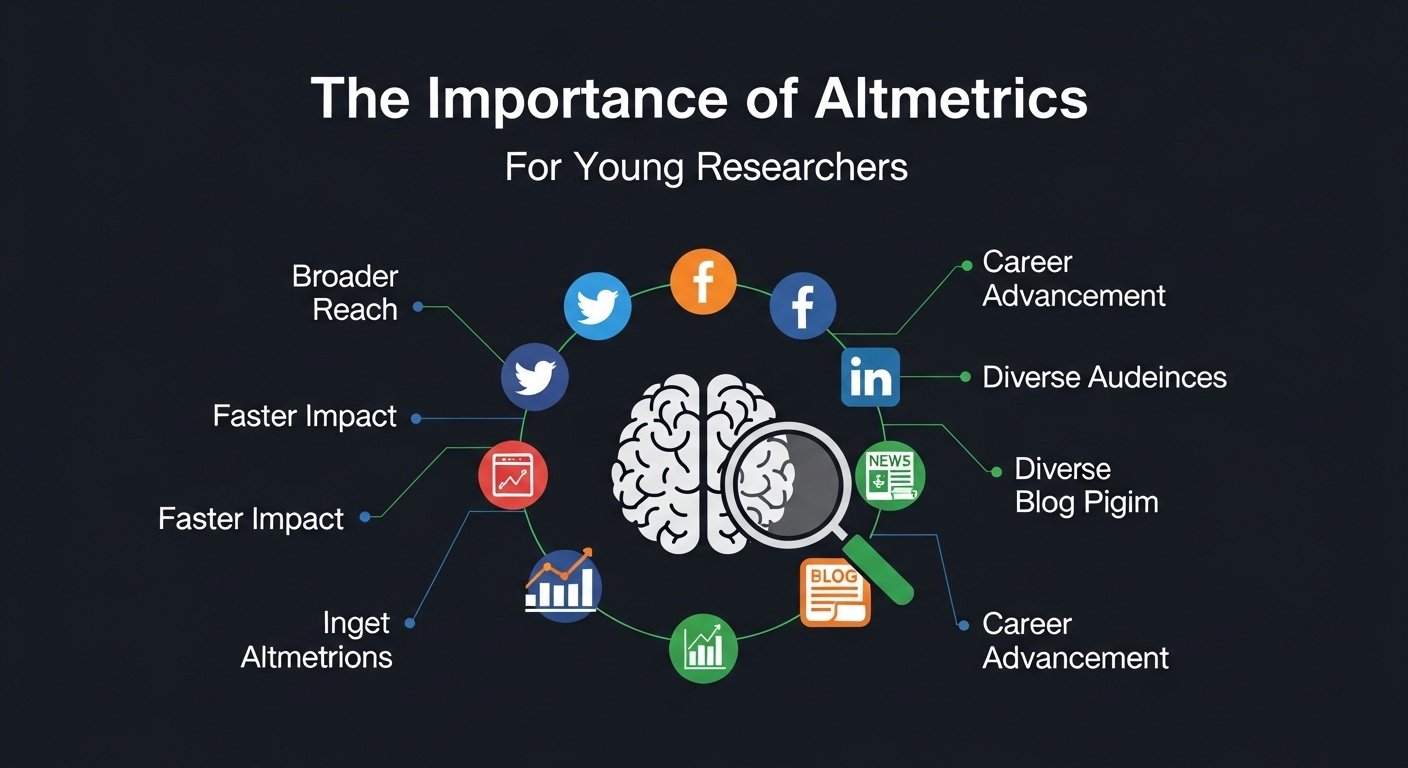
Altmetrics capture the “Conversational” side of research. – **Social Media:** How many times was your paper shared on Twitter/X or LinkedIn? – **News:** Was your work mentioned in a science blog or a national newspaper? – **Policy:** Did a government report or a NGO white paper cite your findings? For a donor, altmetrics for students prove that you aren’t just writing for five other professors; you are writing for the world. It shows you are an “Active Academic” who understands personal brand for students principles.
Why Donors Want to See “Public Impact”
Scholarships are often funded by taxpayers or private philanthropists. They want to see a “Return on Investment.” If your research on renewable energy is being shared by climate activists on TikTok, it shows that your work has “Mobilizing Power.” Altmetrics for students give you a quantitative way to say: “My work isn’t just valid; it is influential.” This is a much more powerful argument than just saying “I got an A in my thesis.”
Using Tools like Altmetric.com and PlumX
How do you find your numbers? This altmetrics for students guide recommends two main tools:
- Altmetric.com: Most journals now have the “Altmetric Donut” on their homepage. It gives you a score based on mentions.
- PlumX: Frequently used by **Elsevier** and **Scopus**, it tracks “Captures” (people saving your paper to Mendeley) and “Usage” (clicks and downloads).
Even if you haven’t published a formal paper yet, you can track mentions of your blog posts or conference posters. Any public intellectual output can have an altmetric score.
Building a “Social” Research Profile
To maximize your altmetrics for students score, you must be proactive. – **Thread it:** When you finish a project, write a 5-post “Thread” on X explaining it in simple language. – **LinkedIn Abstract:** Post a summary on LinkedIn and tag 5 leaders in your field. – **Open Access:** Publish in “Open Access” journals. Research shows that open papers get 3x more altmetric engagement than those behind a paywall. By promoting your work, you are increasing the chances of it being “Captured” by the tracking software.
Altmetrics in Your Scholarship Application
Don’t just list your GPA. Add a section called “Intellectual Reach.” “My recent research on [Topic] achieved an Altmetric score of [X], placing it in the top 5% of all outputs from my university. It was shared by [Organization Name] and featured in [News Outlet].” This is “Social Proof” that a scholarship committee cannot ignore. It proves you are already a full-ride PhD scholarship quality candidate.
Conclusion
The walls of the “Ivory Tower” are falling. Modern research is about “Visibility” and “Utility.” By embracing altmetrics for students, you prove that your brains are matched by your ability to communicate. You turn your research into an “Asset” that generates real-world data points. Start tracking your reach today. Don’t just be a student; be an influencer of ideas. The world is talking about your subject—make sure they are using your words to do it. Your impact is measurable. Go and measure it.
Frequently Asked Questions
Can Altmetrics be “Faked”?
Tracking tools have sophisticated “Bot Detection.” If you buy fake shares, your score will be frozen. Focus on “High-Quality” mentions from verified accounts and organizations.
What if my subject is “Boring” or “Technical”?
No subject is boring! There is a niche for everything. Focus on altmetrics for students within your specific community (e.g., specialized LinkedIn groups or academic blogs).
Are Altmetrics better than Citations?
No, they are “Complementary.” Citations prove “Academic Validity,” while Altmetrics prove “Societal Engagement.” You need both for a balanced profile.
How do I get an ORCID iD?
Go to orcid.org. It is a free, unique number that links all your work together. Without it, Altmetric tools might confuse you with another researcher with the same name.
Do committees really look at these numbers?
In the Tech and Science fields, yes. They are looking for “Future Leaders” who can communicate complex ideas to the public. High altmetrics are a “Signal” of this skill.