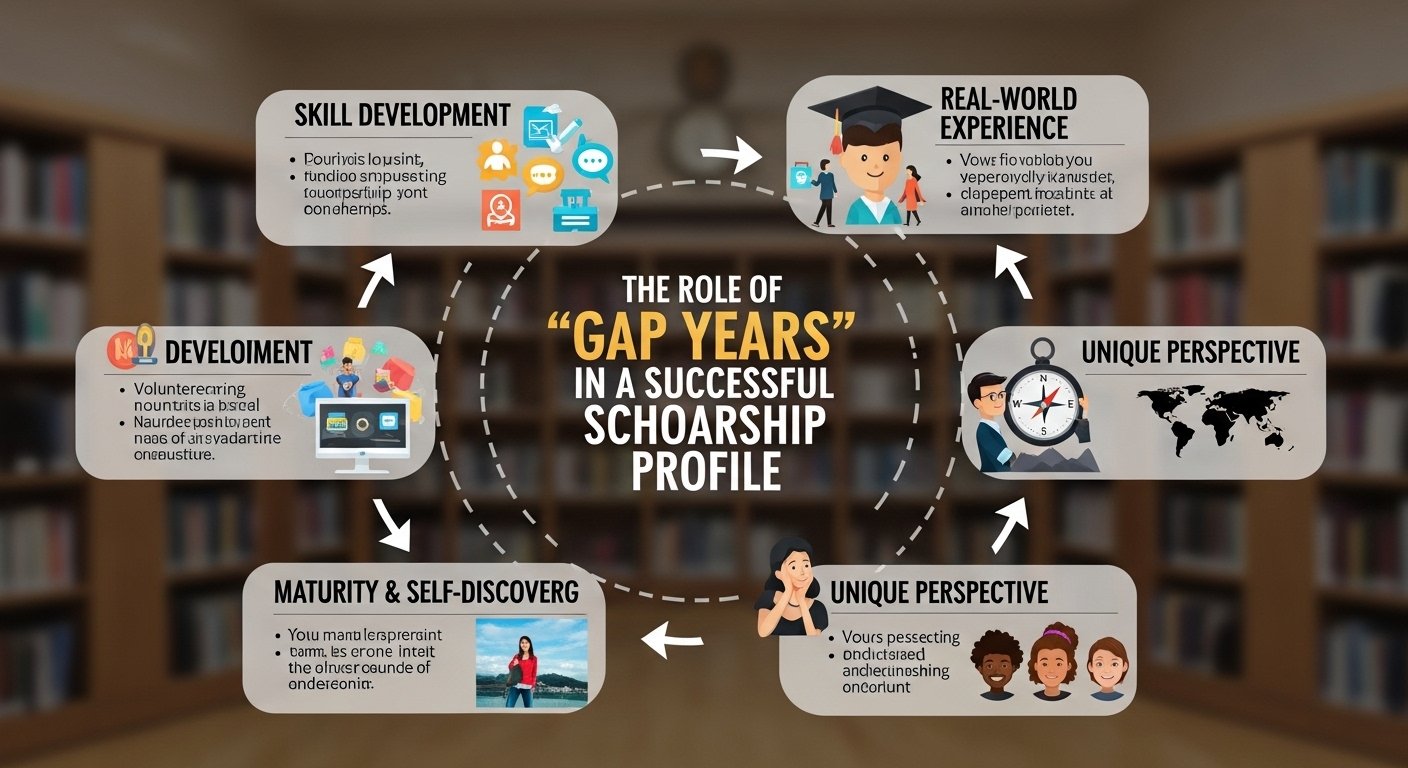
In the past, a “Gap Year” was seen as a sign of laziness or a lack of direction. In 2024, the opposite is true. For elite universities and scholarship committees, a gap year for scholarship applicants is often seen as a period of “Intentional Maturation.” It is a chance to step off the academic treadmill and prove that you can apply your knowledge in the real world. If you use your gap year to work for an NGO, start a small business, or complete a massive personal project, you become a “High-Value” candidate who has more than just grades. In this guide, we explore how to strategically plan a gap year that will make your full ride scholarship application stand out from the “Recent Graduate” crowd.
The “Taboo” is Gone: Why Committees Love Gap Years
Scholarship Committees are looking for “Adults,” not just “Students.” Many 18-year-old or 21-year-old applicants are academically talented but lack life experience. A gap year for scholarship proves that you are ready for the independence of international study. It shows that you can manage your own time, survive in a workplace, and handle complex social situations. By the time you start your degree, you are more focused, more resilient, and more grateful for the opportunity. You aren’t just “continuing school”—you are “choosing education.”
How to Frame a Gap Year as a “Growth Year”
The secret to a gap year for scholarship is the “Narrative.” Don’t call it a “Gap”; call it a “Bridge Year” or a “Year of Service.” – **Incorrect:** “I took a year off because I was tired of school.” – **Correct:** “I dedicated twelve months to an intensive field internship in [X] to validate my research interests before committing to a Master’s degree.” The second option shows that your pause was a strategic decision, not a lack of momentum.
Productive Gap Year Activities for Scholars
To win a full ride scholarship after your gap year for scholarship, you must have “Deliverables.”
- Internships: Work in a field related to your major. Even a “coffee-running” internship at a top lab is better than a year at home.
- Personal Projects: Write a book, build an app, or start a YouTube channel dedicated to your subject. These provide “Tangible Proof” of your passion.
- Social Impact: Local volunteering for a cause you care about (Education, Healthcare, Climate) is the highest-value activity for a scholarship profile.
The Importance of “Linear Progression”
A gap year for scholarship must make sense in your story. If you studied Biology and your gap year was spent working in a fashion boutique, you have a “Narrative Gap.” Try to find activities that “Complete the Circle.” If you find yourself in a job unrelated to your major, do a “Side Project” (as discussed in our student side hustle guide) to keep your academic skills sharp. Your CV should look like a ladder, and the gap year is just a wider, stronger rung.
Explaining the Gap in Your CV
On your CV, don’t leave a blank space. Use a gap year for scholarship header like: “**[Date Range] – Professional Development Year (Focused on [Your Subject])**” Then, list 3-4 bullet points of your main achievements during that time. Use the STAR method! “Secured €2,000 in funding for a local community project” or “Learned Advanced Python for Data Analysis through [X] certification.” This turns the gap into an asset.
Conclusion
A year of life is a year of growth. By taking a gap year for scholarship, you differentiate yourself from the millions of students who go straight from one classroom to another. You gain the “Social Capital” and “Practical Intelligence” that exams cannot measure. Don’t be afraid to slow down to speed up. Your gap year is not a delay; it is an “Engine Tune-up” for the high-performance career ahead of you. Plan it, live it, and then use it to win the world’s best scholarships. The time is yours—use it wisely.
Frequently Asked Questions
Will take a gap year lower my chances at an Ivy League?
No. Schools like Harvard actually encourage admitted students to take a gap year to avoid burnout and gain maturity. It is a sign of wisdom, not weakness.
What if I spent my gap year “Doing Nothing”?
Frame it as “Personal Reflection and Self-Directed Study.” Mention the books you read, the online courses you took, and the “Self-Discovery” you went through. Be honest, but focus on the growth.
Do I need to travel for a gap year?
No. A productive gap year at home (working, volunteering, learning) is more impressive than a year of passive “Tourism.” It’s about what you *did*, not where you went.
How do I get an internship for my gap year?
Use the networking guide for students! Reach out to alumni from your school or local businesses and propose a project-based internship.
Is a “Gap Year” different from a “Gap in Employment”?
Yes. In education, a gap year is a recognized development phase. In employment, it can be a “Red Flag” unless explained. As a student, you have the “Educational Hall Pass” to take this time.