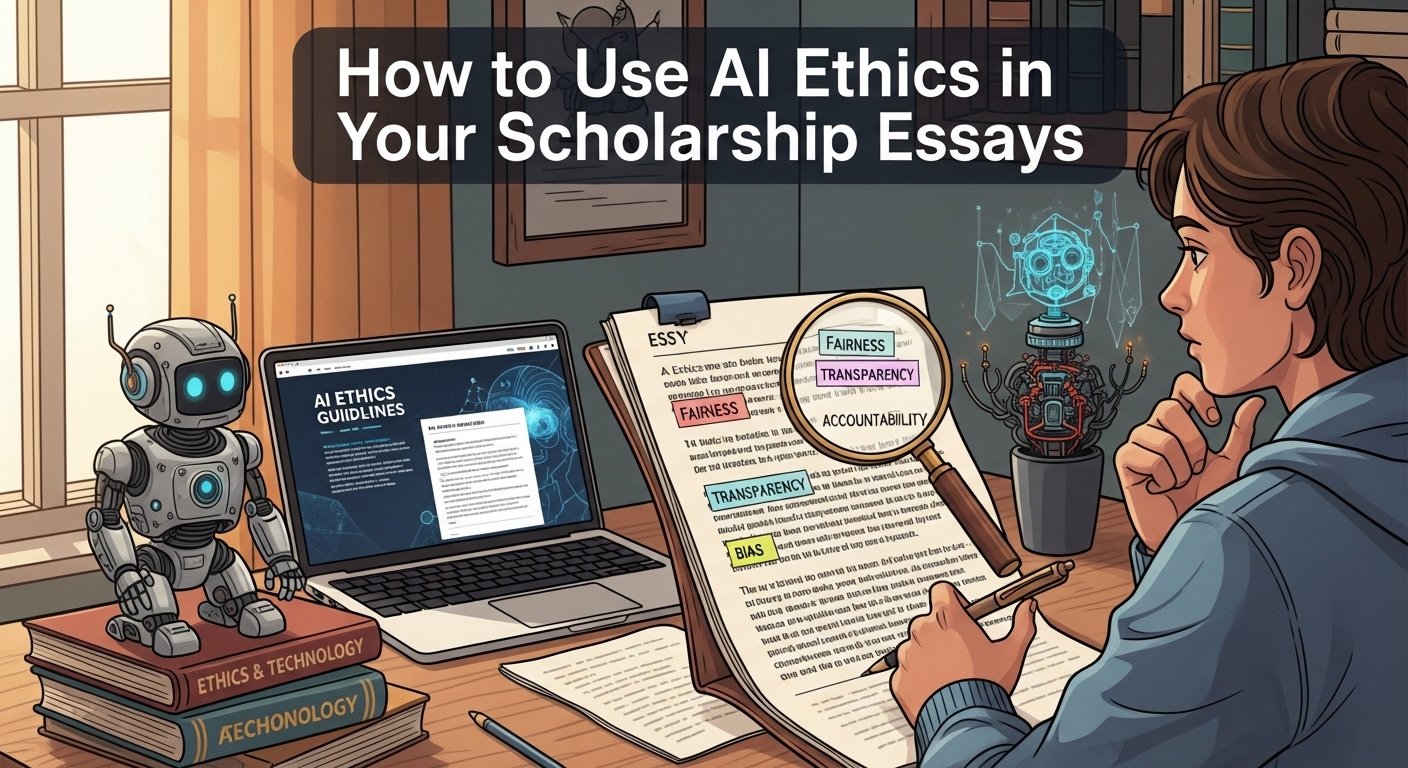
In 2024, if you aren’t talking about Artificial Intelligence, you aren’t talking about the future. However, most scholarships aren’t looking for “AI Fans”—they are looking for “AI Ethicists.” They want to know that you understand the profound risks and societal implications of automation. Whether you are applying for a degree in Law, Medicine, or Art, incorporating AI ethics for students into your personal statement demonstrates higher-level critical thinking. It shows you aren’t just a user of technology, but a responsible citizen of the digital age. In this guide, we explore how to discuss AI responsibility in a way that makes your application sound sophisticated, ethical, and future-ready.
The “Black Box” Problem: Why Transparency Matters
The first rule of AI ethics for students is “Transparency.” Most AI models are “Black Boxes”—we see the input and the output, but we don’t know *why* the AI made its decision. In your essay, discuss the importance of “Explainable AI.” – **In Medicine:** Can we trust an AI diagnosis if it can’t explain its reasoning? – **In Law:** Is an AI-generated legal opinion biased by its training data? By identifying these gaps, you prove that you have the “Systemic Thinking” skills required for prestigious scholarships.
Why “Human-in-the-Loop” Matters
A major pillar of AI ethics for students is the concept of “Human-in-the-Loop” (HITL). This is the idea that AI should supplement human intelligence, not replace it. Use your essay to advocate for this balance. – “I intend to use AI tools to scan vast datasets, but the final ethical interpretation and decision must remain a human responsibility.” This approach protects against “Automation Bias” (the tendency to believe an AI just because it’s an AI) and highlights your personal agency as a researcher.
Demonstrating “Critical Thinking” About Bias
AI is not objective; it is a mirror of its training data. If the data is biased, the AI is biased. AI ethics for students requires an understanding of “Algorithmic Fairness.” Mention how you will ensure that your research or practice accounts for diversity and inclusion. For example, if you are studying architecture, discuss how AI-driven urban design might unintentionally marginalize certain communities. This level of nuance is what separates a “Good” essay from an “Exceptional” one.
The Future of Work and AI Responsibility
How will your future profession change with AI? Don’t be afraid to discuss the “Threats.” AI ethics for students involves looking at the labor market. Discussing the “Just Transition” (ensuring workers aren’t left behind by automation) shows that you have a heart for social justice. Donors love scholars who care about the “Human Impact” of technology. You aren’t just seeking a degree; you are seeking to solve a societal challenge.
Building an Ethical AI Toolkit
If you are following our standardized testing guide for students or our undergraduate research guide, you are already using AI. Build an “Ethics Checklist” for yourself: 1. **Privacy:** Is the data I’m inputting sensitive? 2. **Attribution:** Have I credited the AI (and the original humans it learned from)? 3. **Verification:** Have I fact-checked every statement the AI made? Mentioning this toolkit in your application proves that you are ready for the professional world.
Conclusion
AI is the most powerful tool ever created, but without an ethical compass, it is a dangerous one. By focusing on AI ethics for students, you position yourself as a leader who values truth, fairness, and human dignity. Don’t just show them your IQ; show them your EQ (Emotional Quotient) and your MQ (Moral Quotient). The future is automated, but it still needs human wisdom. Be the scholar who provides that wisdom. Your essay is your platform—use it to speak for an ethical future. The committee is listening; give them something profound to think about.
Frequently Asked Questions
Should I admit to using AI in my essay?
Check the specific university rules. If they allow “AI Assistance for Brainstorming,” then yes—admitting it with “Ethical Attribution” shows honesty and high data privacy for students awareness.
What is “Algorithmic Bias”?
It is when an AI system produces results that are systematically prejudiced against certain groups of people because of the way the model was built or trained.
How do I verify AI outputs?
Always use primary sources. If an AI gives you a “Fact,” find the original academic paper or government website that confirms it. AI can “Hallucinate” (make things up).
Is AI Ethics only for Engineering students?
No! Law, Sociology, Art, Medicine, and History students are all impacted by AI. It is a “Universal Subject” in 2024.
What is a “Digital Sovereign”?
A person who understands their rights online and can navigate technology without being manipulated by it. This is the goal of AI ethics for students.


